Early Citizens
Arenz's Mill
Giessen Emigration Society
Giessen Emigration Society

From Arenz Family of Arenzville, IL - by Molly Daniel
(image above: mill stone from the original mill at Arenzville)
"Located in the fertile farm country of west central Illinois, Arenzville is named for Francis Arenz, an immigrant from Blankenberg, Prussia, who first planned the town in 1839. Residents of the town pronounce the village name with an accent on the first syllable, rhyming with "barns" – (AHRNS—vil).
Situated only ten miles south of Beardstown and the Illinois River, the village lies along a range of loess hills which border a broad expanse of rich farm land. The early migration routes into the region were via the Mississippi and Illinois Rivers, as well as certain overland routes, such as the route between Kaskaskia and Detroit used by French traders in the 1700s.
The withdrawal of the native Kickapoo tribes (around 1819) and the passage of the federal Land Act of 1820 enabling the sale of public land in Illinois attracted hundreds of European settlers to the region. Many of the first non-Native American settlers came overland or via river routes from Virginia, Ohio, Kentucky, and New York.
James Smart, a settler from Barren County, Kentucky, arrived as early as 1823 with his parents. He married in 1825 in Morgan County and settled with his wife, Tabitha Carter, near Indian Creek.[1] He purchased a small mill from the Native Americans still living in the area. A few years later, in 1832, he sold the mill to his brother Bennett Smart, who in turn sold it to Francis Arenz, who had arrived in the territory and purchased the mill and a tract of land near Indian Creek.[2]"
-----
[1] Land records show that James Smart purchased 80 acres of land in section 31, Township 17 North, Range 11 West on 31 Oct 1827. Federal census records show a James Smart with another adult and three children in a Morgan County, IL, household in 1830. James Smart and his family moved to Iowa in 1835, where they lived for more than 45 years. He died in 1883 at Utica, Van Buren County, IA, and is buried in the Miller Chapel Cemetery at Mount Zion, IA. His brother Bennett Smart moved to Hancock County, IL.
[2] Bateman, Newton, Charles Æ. (Charles Aesop) Martin, and Paul Selby. Historical Encyclopedia of Illinois: And History of Cass County, Vol 1. Chicago: Munsell Pub. Co., 1915, p. 22; also Vol. 2, p. 673.
Giessen Emigration Society
Giessen Emigration Society
Giessen Emigration Society

Some of the earliest settlers at Arenzville were people who migrated from Ohio, Kentucky and points further east. Francis Arenz himself, after arriving in America, settled first in Kentucky and then came to Illinois. In the 1830's immigrants arriving from Europe came.
From Arenz Family of Arenzville, IL - by Molly Daniel
"The region saw an influx of German immigrants in the early 1830s, including a small band of the Giessen Emigration Society (Gießener Auswanderungs-gesellschaft), who sailed from Bremen to New Orleans on the Olbers. Arriving on 3 Jun 1834 in New Orleans, they continued northward via the Mississippi and Illinois Rivers to central Illinois. Once they reached Beardstown, they were advised by Francis Arenz to acquire available property near Indian Creek.[1] These families added to a growing community of newcomers in the place that later became Arenzville.
In 1835, Francis Arenz followed his own advice and moved to a farm about 6 miles southeast of Beardstown,[2] and then a few years later, in 1839, to his land near Indian Creek. His brother, John A. Arenz, assisted in creating a plan for a village near the mill that Francis owned. According to Perrin’s History of Cass County, Illinois, “The first lots were surveyed by J.A. Arenz in 1839, and he also made a survey of the town, to be called Arenzville, in 1852, which plot was filed and recorded, August 3, 1852. In 1857, the executors of F. Arenz made an addition to said town, and finally Thomas V. Finney prepared a plot of Arenzville and additions, which was recorded October 20, 1876, in Vol. 31, page 364, and adopted by the town trustees as to the limits of said town, on May 22, 1878, and organizing the town under the State laws. The first organization of the town of Arenzville occurred July 9, 1853, when the first election for town trustees was held.”[3] Francis Arenz was named the first president of the Village’s Board in 1853. His brother Peter served as Village President in 1858 and again in 1860. (John A. Arenz was the first mayor of Beardstown, when it adopted a city organization in 1850.)
One of the earliest mentions of Arenzville is a baptismal record at St. Alexius Catholic Church in Beardstown for Catherine Sutton, a daughter of John Sutton and Catherine McGrath, who was baptized in 1855 at “Arenz Mill.” [4]
-----
[1] Dr. Georg C. S. Engelbach, his sister-in-law Christina Link, his son Herman Engelbach, Joseph Kircher, Friedrich Dickel, Johann L. Ciré (Jr.), a family of Lipperts, and Charles Coerper all settled in Arenzville. Henry Rohn and John Rohn, who settled near Beardstown, were also on the same voyage, as was Henry Rohn’s future wife, Elizabeth Langohr.
[2] Perrin, William Henry. History of Cass County, Illinois. Chicago: O. L. Baskin & Co., 1882, p. 151.
[3]Perrin, p. 147.
[4] A baptismal record made in St. Alexius sacramental records and signed by Father Michael Prendergast shows a baptism “at Arenzmill” on 4 June 1855 for “Catherin of John Sutton & Catherin McGrath. The child 15 months old.”
Latin Farmers

(image: Arenzville Band - year not known)
From Perrin's History of Cass County, 1882:
"Among the early emigrants from Germany, were many who had been accustomed to good society, and had enjoyed the advantages of superior education. Some held diplomas from colleges and universities. As most Germans, they were lovers of music, and some could play on one or more musical instruments. The pioneer lives in a new country, where hard labor, coupled with innumerable privations, without amusements of any kind, necessarily drew that class together, who could not bring themselves to the belief that the only aim and object in life should henceforth be devoted to hard work only, for which they at best could only get board and clothing. They were generally called the "Latin farmers." A club, or society circle was formed, and social gatherings were had, sometimes at the house of one member, sometimes at another. Little concerts were gotten up, the instruments being piano, violin, flute, and violoncello. Dancing parties were occasionally arranged, and large hunting parties. A musical band was afterward organized under the leadership of a Mr. Holtzermann. This social circle continued for many years, until finally, when the number had increased to such proportion that no room was large enough to hold them, and some of the original members had by death, or removal to other parts of the country, made their places vacant, this very pleasant and useful club came to an end."
Inventive Farmer
From Perrin's History of Cass County, 1882:
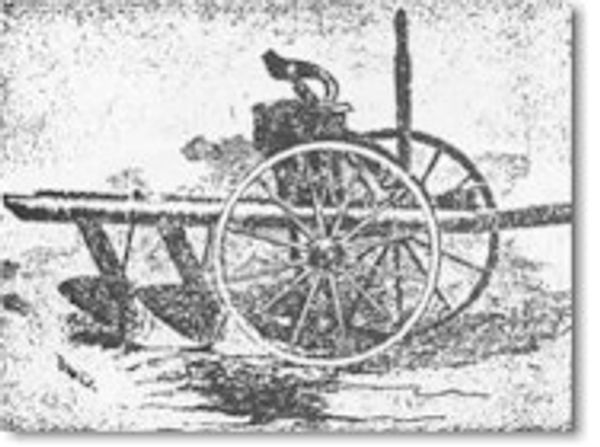
Arenzville has had lots of interesting people in its past, including a man who invented the spring seat plow. J.C. Pfeil, a friend of Francis Arenz and native of Germany, built the spring-seat gang plow. He was a tailor by training but took a suggestion from Jonathon Baldwin Turner, professor at nearby Illinois College, that it made no sense for a man to walk behind a plow all day long when horse feed is so cheap. Pfeil used his inventiveness to create a plow which allowed a place for the farmer to sit while guiding the horse. [Information and photo found in A Local History Collection of Arenzville, Illinois, by Theodore and Hester Ham Lovekamp, 1988.)
Some of the same families who came to central Illinois looking for good farm land in the middle of the 19th century have descendents who still live in the region. Read biographical sketches of some of Arenzville's early residents from Perrin's History.